Welcome

Welcome to my photo journal.


Tuesday, March 26, 2013

N. Ft. Myers Eaglets

 Our first view of a baby, Jan. 15th.
The eaglets hatched Jan. 1st and 3rd and were named Honor and Hope.
 The proud parents, Ozzie and Harriet.
 Eaglet and parent on Jan. 28th.
 Finally see both eaglets.
 Some of the eagle watchers.
 Eaglets on Feb. 4th.
 Wow, have they've grown, it's only Feb. 22.
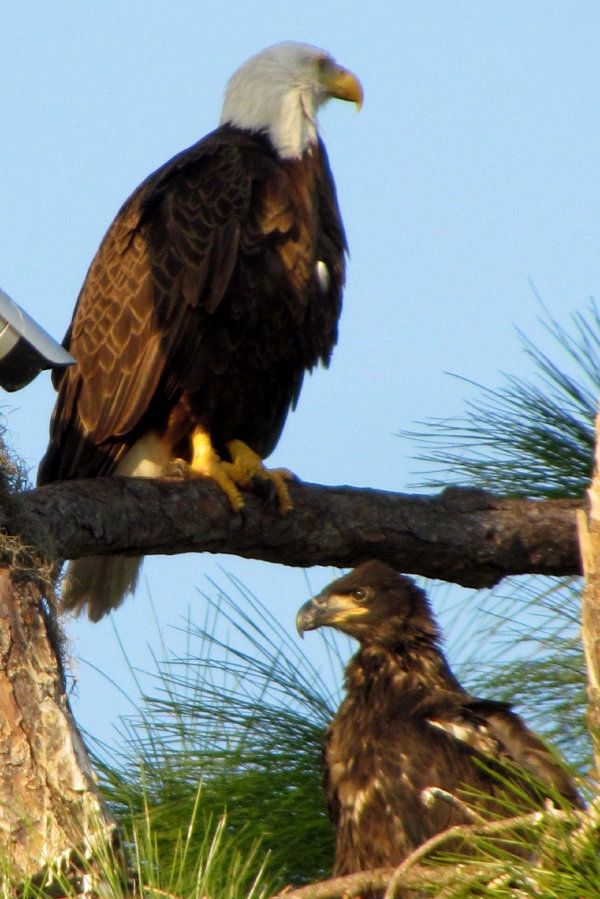
 Taken around Feb. 25th.
 By March they are as large as their parents.
 They are learning to feed themselves but mom likes to help them out.
 A few eagles fans.
 An eaglet takes it's first flight March 25, but we missed it this is the next day's flight.
It is fun to see how they slowly learn to fly about going from tree to tree and sometimes landings are missed and they end up on the ground then struggle to get back up in the air.  They should have down in a couple more days.
Then  they will be learning to find their own food and they may follow their parents north for the summer.
Some fun facts on eagles:
There are only two states with a larger population of eagles than Florida, and they are Alaska and Minnesota.
Eagles can lift 4 lbs.
An eagles nest can have 4,000 pounds of  nesting material.
The N. Ft. Myers eagle cam has had more than 15 million views from more than 200 countries.

We have had fun watching these eagles, taking photos of them and meeting some of the people who come by to see the eagles.  We will miss them and we will all be heading north sometime in April.

Monday, March 18, 2013

A bit of Naples


Taken from parking lot at Clam Pass Beach
 This past week week we have been visiting the birding spots around Naples, which is just down the road from Ft. Myers about a  20 min drive.
Beach at Naples Pier

Naples Pier is considered one of the oldest piers in the states, it has been repaired three
times after hurricanes hit it.
Naples Pier
Eagle Lake Park
 We found that Eagle Lake Park the best place to see birds in Naples, there are 2 State Parks and a Preserve but we found very few birds at those.  
At Eagle Lake Park we did see two juvenile eagles, an osprey family, a spoonbill, storks, American Pelicans,
white and glossy ibis, and all the herons.
Clam Pass beach
 We met a birder at Eagle Park and he said he liked Clam Pass beach especially for Black Skimmers.
Resting Black Skimmers

Skimmers disturbed.
This is what uninformed people do, walk through the resting birds, not the thing to do and the sad thing was the birds returned to rest and they walked through them again til most of the birds left.
This is why we like to hit the beaches early before the sun bathers arrive it is the only way we can see any birds and get photographs.

Tuesday, March 12, 2013

 This week I saw my first baby Osprey, there are two in this nest .
Looks like mom doesn't it.
 I've been watching the nests in the area and there are a lot of osprey nests.
The state puts up poles for nesting but these birds thought this tower was better.
The  platform below is located next to a Walgreen we visit a lot so I have fun
watching the family add to the nest and I believe I saw a baby's head 
the last time we were there. Hopefully I'll get photos of them soon.
There is also a nest on a light near the McDonald's we visit but
I haven't noticed any little heads there yet.
There was a nest made on a light in the Walmart parking lot but
the ospreys abandoned it, I blame all the grackles and gulls for that.
   

 We saw our first house finch in Florida last week, we looked in the bird book and I guess they are not a common bird here like they are back home.  

 These Palm Warblers are very common, we have a couple pairs that visit our grapefruit tree.
We see them everywhere.  Another common bird back home the house sparrow isn't very abundant here either, we do see them but not at our feeder.
Our feeder birds are  mourning doves, blue jays, common grackles, red bellied woodpeckers and cardinals.
There are several eagle nests in the area too, this one is right next to a busy traffic corner and a very busy shop.  It has a couple of babies.  We need to go back to see them as they should be close to fledging.
We visit the N. Ft. Myers eagles several times a week, it won't be long and they will be flying.
I'll do a post of their growth in a couple of weeks.

Sunday, March 3, 2013

Signs of Spring

Iris found in the sloughs
 A major sign that it's spring in Florida is when the Cypress trees are green again.
They loose their leaves around Dec. and just the last week they have greened up again,

 This Cypress was just beautiful and these Ibis' made it extra special.
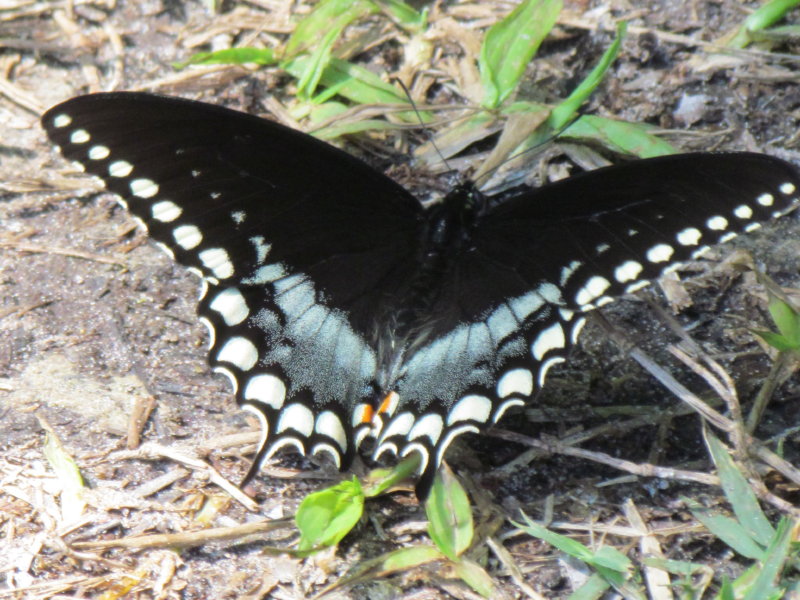
Butterflies can be seen all winter like this Spricebush Swallowtail we saw today enjoying the sun after a very cool night in the low 40's.

Saturday, February 23, 2013

Lover's Key State Park

Two Oyster Catchers we were lucky to see on one of our visits.
 Lover's Key is one of our favorite low tide places to visit for gathering shells and looking at the live sea animals digging in to wait for the tide to come in.
We haven't visited Lover's Key in a few weeks, we've been focusing on birds and the Key doesn't have as many as Bunche Beach.
 This is a Fighting Conch working it's way back to the water but has run into a road block.
 This is just one of a few sea anemones I found on the beach, if you touch it it will squirt back at you.
 A track of a Sea Star.
 Old trees on the beach.
A crab, I haven't learned my crabs yet.

 A couple of Olives digging into the sand to wait for the tide to come in.
There are several osprey nests in the old trees that line the beach.
I think it's time to go back and see how the Ospreys are doing,
They are probably sitting on their eggs which they do for around 48 days.

Sunday, February 10, 2013

Ding Darling Wildlife Refuge

Ding Darling is a favorite destination for tourists and birders, it is located on Sanibel Island.
J.N. Darling was a editorial cartoonist for the Des Moines Registor and his cartoons were syndicated  to major newspapers.  He was so interested in conservation of wildlife he started the Duck Stamp program.
 

 Friday we joined Don and Lillian Stokes on their fundraising  tour of the refuge.  
The refuge is normally closed on Fridays to allow the volunteers to do some clean up and staff to do some research and testing of the waters.
 Reddish Egret starting to get it's breeding plumage.
 Fiddler crabs.
 There are three major ponds to view wildlife and the best time to visit is low tide when you will find the birds resting and feeding on the sandbars. There are volunteers stationed along the road to help with questions and sometimes they had a spotting scope to help you spot and identify the birds.
 But the birds also like to roost in the trees as these egrets are doing and as you drive along look in the open areas for night herons and anhingas and if lucky an alligator.

 American pelicans are numerous here.

 The refuge also has Bailey's track another spot to visit on Sanibel Island, it is not as well visited as the main refuge as you have to walk it.  Here we found the Clapper Rails and Sora and several alliagators.
 This is a Mangrove crab a tiny crab hard to spot and there is usually a volunteer to help you spot them.
This looks like it could be a relative of the poinsettia plant, I haven't discovered it's name yet.
We have visited the refuge several times and each time we find something new.

Thursday, January 31, 2013

Bunche Beach


This week I thought I'd share another favorite birding spot, Bunche Beach.  It's great when the tide is low and  the birds are feeding.  You'll find several photographers and birders there in the early morning during low tides to watch the birds.
The bridge behind takes you to Sanibel Island.

 This Reddish Egret has a mullet.
 This Sanderling found a worm.
 We believe this pile of mud is made by the worms.
 Black Skimmers resting on a sand bar.
 A little stream flowing into the gulf  at Bunche Beach.
 Bubbles made by this King's Crown, you can see the little guy's nose.
 Early morning at Bunche Beach a birder's scope is waiting for action.
 This jelly bubble is made by a worm to protect itself from the birds.
 Just a few bird tracks.
King's Crown Conchs burying themselves to wait for the in coming tide.
I'm looking forward to the next low tide to visit Bunche again.

January is gone and we counted 112 species of birds for the month, not a bad start for the year.